Tag: memory

  • 🖤 Between the Lines #11: What the Dead Keep

    I think one of the strangest things about grief is that you don’t always miss the huge moments first.

    Sometimes you miss the stupid little things.

    What flowers somebody hated.

    How slowly they drank their wine.

    The sound they thought was funny.

    The person you loved is gone, but Tuesday still happens.

    And I think that is really what this poem became about for me.

    Not refusing to let someone go.

    Not being unable to move on.

    Just the quiet, stubborn way love can keep making room for someone who is no longer physically there.

    Because there is a difference between accepting that someone died—

    and deciding that death gets to erase them.

    This is What the Dead Keep.


    What the Dead Keep

    Every night,

    someone leaves flowers
    on a grave

    whose name
    has long withered away.

    Not roses.

    She hated roses.

    He remembers that.

    Even now.

    Even after rain
    has eaten the letters
    from the stone

    and moss has filled
    what little remains.

    He brings lilies.

    Sometimes dahlias.

    Once,

    in the middle of winter,

    he walked three miles
    through snow

    with violets
    hidden beneath his coat

    so the frost
    wouldn’t touch them.

    By morning,

    they were frozen anyway.

    He came back
    the next night.

    He always comes back.

    The cemetery gate
    screams when he opens it.

    He never oils the hinge.

    She used to love
    that sound.

    Said it made the place
    feel haunted.

    He had laughed then.

    “It’s a cemetery.”

    She smiled.

    “Exactly.”

    Now,

    he would give anything

    to hear her laugh
    at him again.

    So every night,

    he kneels
    in the dirt.

    Pulls weeds
    from around the stone.

    Brushes dead leaves
    from her name.

    Runs his thumb
    through the shallow grooves

    as though touching
    the letters

    might somehow
    still count

    as touching her.

    Sometimes
    he talks.

    Nothing important.

    The neighbor
    finally cut down
    that awful tree.

    The roof leaks again.

    He burned dinner
    on Tuesday.

    The moon is full.

    He tells her
    the ordinary things

    because death
    already took
    everything else.

    He refuses
    to let it have

    Tuesday.

    Sometimes,

    he brings two glasses
    of wine.

    Pours hers
    into the earth.

    “You always drank too slowly.”

    The soil turns dark.

    He drinks alone.

    Years pass.

    The groundskeeper changes.

    Then changes again.

    Houses rise
    beyond the cemetery walls.

    Children become old enough
    to have children.

    People stop visiting
    the graves nearby.

    Photographs fade.

    Names disappear.

    Stone forgets
    what flesh once was.

    But every night,

    flowers.

    Fresh.

    Carefully cut.

    Placed beneath
    a name

    no living person
    seems to recognize.

    Eventually,

    people begin telling stories.

    A grieving husband.

    A ghost.

    A madman.

    A lover
    who cannot let go.

    They are wrong
    about one thing.

    He did let go.

    He let go
    of her hand

    the night
    it became too cold
    to hold him back.

    He let strangers
    carry her away.

    Let them close
    the coffin.

    Let dirt strike wood

    one handful
    at a time.

    He let go

    because the living
    are forced

    to do terrible things
    with their hands.

    But love—

    love was never buried.

    So tonight,

    he comes again.

    Slower now.

    His hands shake
    around a bundle
    of white lilies.

    He lowers himself
    beside her

    with more difficulty
    than he used to.

    His knees sink
    into wet earth.

    For a long time,

    he says nothing.

    Then he places
    the flowers down.

    Straightens each stem.

    Wipes a smear of mud
    from the stone.

    And rests his forehead
    against her name.

    “I’m tired, darling.”

    The cemetery
    does not answer.

    It never does.

    He smiles anyway.

    Small.

    Almost embarrassed.

    Like the young man
    who once stood
    on her doorstep

    holding flowers

    and trying desperately
    not to crush them.

    “Tomorrow, then.”

    He kisses
    two fingers

    and presses them
    to the stone.

    Then leaves.

    The gate screams
    behind him.

    Morning comes.

    The lilies remain.

    Then another night.

    And another.

    But no footsteps
    cross the cemetery.

    No hands
    clear the leaves.

    No voice
    complains about the weather.

    For the first time
    in sixty-three years,

    her grave

    is alone.

    Until spring.

    When the groundskeeper
    finds something strange.

    Two graves.

    Side by side.

    One stone
    so old

    its name has nearly
    disappeared.

    The other,

    new.

    And growing
    between them,

    where no one
    remembers planting anything,

    a cluster

    of white lilies.


    Between the Lines

    This poem looks like a ghost story.

    There’s an old cemetery.

    A screaming gate.

    A disappearing name.

    A man who comes every night for sixty-three years.

    Flowers growing between two graves at the end.

    But I don’t actually think this is a poem about ghosts.

    I think it’s about being remembered after the world has stopped remembering you.

    The stone is failing.

    Rain is eating the letters.

    Moss is filling the grooves.

    Eventually, nobody seems to know who the woman buried there even was.

    But he does.

    And not in some grand, romanticized way where she becomes perfect because she died.

    He remembers that she hated roses.

    That matters to me.

    He doesn’t bring her the flower people are supposed to bring the dead.

    He brings her flowers.

    Lilies.

    Dahlias.

    Violets he tries to protect from the snow even though they freeze anyway.

    He remembers her jokes.

    Her habits.

    The tiny things that made her a person.

    Death gets the body.

    Time gets the photograph.

    Weather eventually gets the name carved into stone.

    But he keeps the details.


    “He refuses to let it have Tuesday.”

    This might be my favorite part of the whole poem.

    Because grief is usually written around the enormous things.

    The funeral.

    The final goodbye.

    The empty side of the bed.

    The anniversary.

    But losing someone also means losing the person you would have told about Tuesday.

    The roof leaked.

    The neighbor finally cut down the tree.

    You burned dinner.

    Nothing important happened.

    And you still would have told them.

    He keeps bringing her the ordinary life she would have been part of.

    Death already took the things he couldn’t stop it from taking.

    He isn’t giving it the mundane stuff too.

    Not Tuesday.


    “A lover who cannot let go.”

    That is what people eventually decide he is.

    But they’re wrong.

    He did let go.

    Literally.

    And I think this is probably the hardest part of the poem for me:

    He let go

    because the living
    are forced

    to do terrible things
    with their hands.

    There is something cruel about how physical death is for the people left behind.

    Someone has to release the hand.

    Someone has to let strangers take the body.

    Someone has to close the coffin.

    Someone has to leave the cemetery.

    His continuing to love her afterward does not mean he failed to accept that she died.

    He knows she is dead.

    The poem never gives him an answer.

    “The cemetery does not answer. It never does.”

    He just doesn’t believe acceptance requires forgetting.

    And neither do I.


    “Tomorrow, then.”

    By the time he comes for the last time, he is old.

    His hands shake.

    His knees hurt.

    Everything around him has changed.

    But he is still carrying white lilies.

    Then, for a moment, he becomes that young man again—

    standing on her doorstep with flowers and trying not to crush them.

    I love that image because sixty-three years disappear for a second.

    Then he says:

    “Tomorrow, then.”

    And there isn’t one.

    Not for him.

    That hurts me more than some huge final goodbye ever could.

    Because most people don’t know when something is the last time.

    The last conversation.

    The last ordinary Tuesday.

    The last see you tomorrow.

    Sometimes you only realize afterward that tomorrow belonged to somebody else.


    And then there are the lilies.

    I deliberately don’t explain them.

    Maybe somebody planted them.

    Maybe they grew there naturally.

    Maybe it is coincidence.

    Maybe it is something else.

    I don’t really care.

    For sixty-three years, he carried flowers to her.

    Then he dies.

    And in spring, flowers grow between them.

    Not on her grave.

    Not on his.

    Between.

    I don’t need that ending to prove an afterlife.

    I just like the idea that after all those years spent crossing the distance between the living and the dead, the poem ends with something quietly growing in the space that separated them.


    What the Dead Keep

    Maybe that’s what we really keep when somebody dies.

    Not the person.

    We don’t get that choice.

    We keep fragments.

    Habits.

    Private jokes.

    Things they hated.

    Things they would have laughed at.

    The stupid ordinary details that don’t sound important until suddenly they are all you have left.

    The stone eventually forgets her.

    The world mostly does too.

    He doesn’t.

    And then eventually, he is gone as well.

    But for one spring—

    white lilies grow between them.

    Maybe nobody visiting that cemetery knows why.

    Maybe nobody remembers either of them.

    But something is still there.

    And maybe that is as close as any of us get to staying.

    Until next time,

    — Destiny

    P.S. If someone you loved were gone, what ordinary little thing about them do you think you’d be most afraid of forgetting? 🖤
  • 📷 Learning to Look Closer #12: Between the Songs

    Concert photography makes you want to chase the obvious moments.

    The singer at the microphone.

    The lights hitting perfectly.

    The crowd with their hands in the air.

    The big moments.

    But sometimes I like the ones in between better.

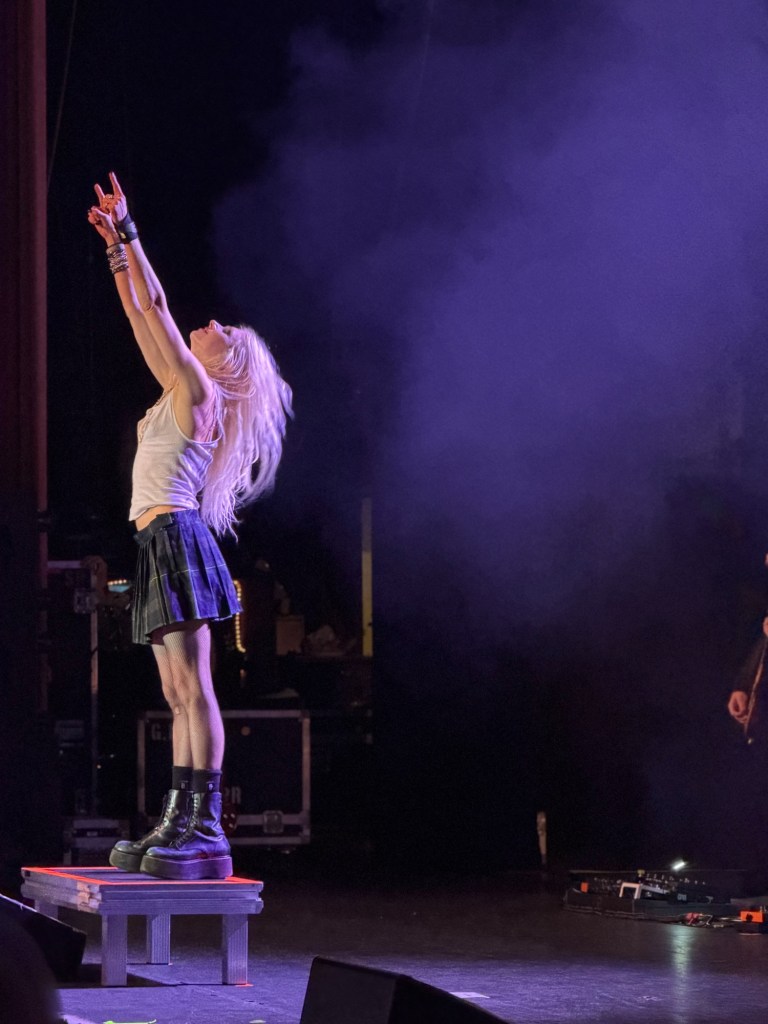
    I took this photo at the concert, and there isn’t actually a whole lot happening in it.

    She isn’t singing into a microphone.

    There isn’t a giant explosion of lights behind her.

    There aren’t a hundred things fighting for your attention.

    It’s just her.

    Standing on the edge of the stage.

    Arms stretched toward the ceiling.

    Purple light and smoke filling almost everything around her.

    And somehow, that makes her feel even smaller and the moment feel even bigger.

    That’s what I keep coming back to when I look at this picture.

    The space.

    I could have cropped most of it away.

    I could have brought her closer and made her fill the frame.

    But I don’t think I want to.

    Because the empty space is part of the photograph.

    It shows how big that stage felt.

    How much atmosphere was hanging in the air.

    How one person can take up such a tiny part of a photograph and still be the first thing your eye finds.

    And I love the way she’s reaching into all of it.

    There’s something about concerts that photographs never quite capture.

    You can photograph the artist.

    You can photograph the lights.

    You can photograph the smoke.

    But you can’t really photograph the bass vibrating through your chest or the sound of hundreds of people singing the same words.

    You can’t photograph what it feels like to hear a song you love performed right in front of you.

    But every once in a while, I take a picture that feels like it caught a tiny piece of that feeling anyway.

    I think this is one of those.

    Not because I caught the biggest moment.

    Because I noticed the smaller one.

    And sometimes, when I look closer, those are the pictures I end up loving most.

    Until next time,
    —Destiny

    P.S. When you take pictures at concerts or events, do you usually photograph the big moments—or the little ones happening in between?

  • Between the Lines #8: Little Star

    Some poems start with an idea.

    Others start with a line you’ve known so long that you almost don’t hear the words anymore.

    “Twinkle, twinkle, little star…”

    It’s one of the first songs a lot of us learn as children. We sing it before we know what stars actually are. Before we understand distance. Before we understand that the light reaching us might have been traveling for years.

    And before we learn that sometimes, the thing we’re looking at may already be gone.

    That thought stuck with me.

    Because there’s something strangely human about that.

    So I followed it.

    And it got darker than the nursery rhyme. 😅


    Little Star

    Twinkle, twinkle, little star,

    I used to wonder
    what you are.

    Before I learned
    that some lights

    are already dead.

    That sometimes
    we spend our whole lives

    looking at something

    that disappeared
    centuries ago.

    No one tells children that.

    We point toward the sky
    and call it beautiful.

    Make wishes
    on burning things.

    Teach them
    to close their eyes

    and ask the universe

    for whatever
    their tiny hearts desire.

    I wonder

    how many wishes

    were sent

    to something

    that wasn’t there

    to receive them.

    Maybe that’s why
    mine never came true.

    I used to lie
    beneath my blankets

    and watch the stars
    through my window.

    I thought

    they were watching back.

    Guardians.

    Tiny holes in heaven

    letting the light through.

    I didn’t know yet

    that darkness

    was the natural state
    of things.

    That light

    had to fight

    just to reach us.

    Sometimes,

    I still look up.

    Not to wish.

    I stopped doing that
    a long time ago.

    Now I count

    the dead things

    still shining.

    One.

    Two.

    Three.

    There are too many.

    And I wonder

    how long

    a person can disappear

    before everyone else

    notices

    their light

    is only a memory.

    How many times

    have I smiled

    after something inside me

    had already gone dark?

    How many people

    have looked at me

    and thought,

    She’s doing so well.

    Because they were seeing

    light

    that left me

    years ago?

    Maybe we are all

    a little like stars.

    Carrying old versions
    of ourselves

    across impossible distances.

    Letting people

    make wishes

    on pieces of us

    that no longer exist.

    Twinkle, twinkle,

    little star.

    I finally know

    what you are.

    Proof

    that something

    doesn’t have to be alive

    for its absence

    to take years

    to reach us.


    Between the Lines

    What got me about the idea behind this poem wasn’t really the stars.

    It was the delay.

    The idea that light can keep traveling after its source has changed—or disappeared entirely.

    And I started thinking about how often people do that, too.

    There are versions of ourselves that other people continue to see long after we’ve stopped being them.

    Maybe they remember the version of you who tolerated things you don’t tolerate anymore.

    The version who trusted more easily.

    The version who was louder.

    Softer.

    Happier.

    More naive.

    Maybe they’re looking at who you were five years ago and assuming that person is still standing in front of them.

    And sometimes, it happens in reverse.

    Sometimes we’re the ones sending out old light.

    We smile.

    We go to work.

    We answer messages.

    We make jokes.

    We tell people we’re fine.

    And from where everyone else is standing, we might genuinely look fine.

    They aren’t necessarily ignoring what’s happening inside us.

    They may simply be seeing the light that reached them.

    That’s where the line—

    How many people
    have looked at me
    and thought,

    She’s doing so well.

    —came from.

    There’s something sad about realizing that someone can look directly at you and still be seeing an older version of you.

    But I don’t think Little Star is entirely about sadness.

    I think it’s also about change.

    We spend our lives leaving versions of ourselves behind.

    Some disappear quietly.

    Some take years to let go of.

    Some probably still exist in somebody else’s memory exactly as we were when they last knew us.

    And maybe that’s okay.

    Because the person I was isn’t necessarily gone just because I’m not her anymore.

    Some of her light made it here.

    I carry pieces of her.

    Other people carry pieces of her.

    And someday, the person I am right now will probably become another one of those distant versions too.

    Still visible.

    Still affecting something.

    Just no longer the whole story.

    Maybe that’s what I like most about the stars.

    We look up and think we’re seeing what is.

    Sometimes we’re actually seeing what was.

    And unless we look a little closer, we may never know the difference.

    Until next time,

    —Destiny

    P.S. Some things keep shining long after they’ve changed. Maybe people do, too.

  • Between the Lines #6

    When the Night Whispers Your Name

    There’s something unsettling about hearing your name when no one said it.

    Maybe you’re lying in bed.

    Maybe the house is completely quiet.

    And for half a second, you could swear someone called you.

    Not loudly.

    Just enough to make you stop.

    Listen.

    Maybe even look over your shoulder.

    That was the thought behind When the Night Whispers Your Name.

    At least, that’s where it started.

    Because somewhere while writing it, the person whispering stopped being a ghost.

    And started becoming me.


    When the Night Whispers Your Name

    When the night whispers your name,

    I pretend

    I didn’t hear it.

    I’ve learned

    that some voices

    don’t belong

    to the living.

    Not because they’re ghosts.

    Because memory

    has a remarkable way

    of learning

    how to breathe.

    The daylight

    is kinder.

    It fills empty rooms

    with enough noise

    that I can almost believe

    I’ve become someone else.

    But night—

    night has always

    known the truth.

    It remembers

    every version of me

    I’ve tried

    to outgrow.

    The child

    who mistook silence

    for safety.

    The teenager

    who carried storms

    inside her ribs.

    The woman

    who still apologizes

    before she takes up space.

    They all answer

    when the darkness calls.

    I don’t.

    At least,

    I tell myself

    I don’t.

    But there are evenings

    when I catch myself

    looking over my shoulder

    because I could have sworn

    someone

    just said my name.

    Softly.

    The way people do

    when they love you.

    Or miss you.

    Or mourn you

    before you’re gone.

    Maybe that’s what

    the night has been

    trying to tell me.

    Not that I’m haunted.

    That I have spent

    so many years

    running from myself

    that even my own name

    sounds unfamiliar

    when spoken

    with kindness.

    When the night

    whispers your name,

    listen carefully.

    It may not be

    calling you backward.

    It may be asking

    whether you’ve finally

    become brave enough

    to turn around

    and meet

    the person

    who has been searching

    for you

    all along.


    I think there are certain versions of ourselves we spend years trying to leave behind.

    Not necessarily because we hate who we were.

    Sometimes we just don’t want to remember what that version of us had to carry.

    So we grow.

    We change.

    We get older.

    We build lives around everything that happened afterward.

    And eventually, we start telling ourselves that person doesn’t exist anymore.

    But I don’t think it works like that.

    I think every version of us leaves something behind.

    The child.

    The teenager.

    The person who was scared.

    The person who was angry.

    The person who survived something they didn’t have words for yet.

    They don’t disappear just because we become someone else.

    And sometimes, when everything gets quiet enough, we hear them.

    That’s why I wrote:

    Because memory
    has a remarkable way
    of learning
    how to breathe.

    Memory can feel incredibly alive.

    A smell can bring back a room you haven’t stood in for years.

    A song can bring back a person.

    A sentence can bring back a feeling you thought you’d forgotten.

    And sometimes you can be sitting perfectly still in the present while some part of you is somewhere else entirely.

    That’s its own kind of haunting.

    But I didn’t want this poem to end there.

    Because When the Night Whispers Your Name isn’t really a poem about being haunted by who you used to be.

    It’s about finally turning around.

    There’s a line toward the end that I think holds the entire poem:

    That I have spent
    so many years
    running from myself
    that even my own name
    sounds unfamiliar
    when spoken
    with kindness.

    Sometimes we become so accustomed to criticizing ourselves that kindness feels suspicious.

    Sometimes we’re much better at extending grace to the people we used to be than the person we are right now.

    And sometimes the version of ourselves we’ve been trying so hard to escape isn’t chasing us at all.

    Maybe she’s just waiting to be acknowledged.

    Maybe she wants someone to finally look at her without shame.

    Maybe she wants to hear her own name spoken gently.

    So perhaps when the night whispers your name, you don’t always have to run from it.

    Sometimes you can turn around.

    Sometimes you can listen.

    Sometimes you might discover that the thing you thought was haunting you…

    was simply a piece of yourself waiting for you to come back.

    Until next time,

    — Destiny

    P.S. If you could sit down with one past version of yourself for five minutes, which version would you choose—and what would you tell them?

  • Between the Lines #4: When the Wind Carries Secrets

    Some things are easier to say when you don’t know who’s listening.


    When the wind carries secrets,
    I wonder if mine
    are still looking for me.

    I have whispered so many things
    into the open air—
    names I no longer say aloud,
    prayers that never reached heaven,
    apologies that belonged
    to someone else.

    I imagine the wind
    keeping them all.

    Tucking them beneath its ribs,
    carrying them over oceans,
    through forests,
    past houses where little girls
    still believe their mothers
    will always protect them.

    Maybe that’s why
    it never stops moving.

    Maybe grief
    has made it too heavy
    to rest.

    I have secrets
    that still wake before I do.

    Secrets that smell like hospitals
    and old bedrooms.

    Secrets that remember
    what my body spent years
    trying to forget.

    I don’t think silence
    buries anything.

    I think it teaches memories
    how to echo.

    Sometimes the wind
    finds me again.

    It slips through cracked windows.
    Lifts my hair from my shoulders.
    Whispers my own voice
    back to me—

    only older.

    Softer.

    Like someone
    who survived the telling.

    I wonder
    how many of us
    are breathing
    the same air.

    How many confessions
    have passed through my lungs.

    How many mothers
    never heard the words
    their children carried.

    How many lovers
    mistook silence
    for peace.

    The wind knows.

    It has listened
    to every goodbye
    spoken too late.

    Every I’m sorry
    that arrived
    after the damage.

    Every I love you
    that died
    on the tip of a tongue.

    When the wind carries secrets,

    I hope it carries this one gently—

    I survived.

    Not gracefully.

    Not without breaking.

    But enough

    that I can finally say it

    without whispering.

    And maybe,

    just maybe,

    the wind isn’t carrying my secrets away.

    Maybe

    it’s carrying them

    to someone

    who thought

    they were the only one.


    I think some things become harder to say the longer we carry them.

    Eventually, they stop feeling like words and start feeling like weight.

    That’s where this poem came from.

    I liked the idea of the wind as something that has heard everything—the things we whispered when nobody was around, the apologies we never received, the words we never managed to say, and the stories we spent years keeping quiet.

    But somewhere while writing it, the wind stopped feeling like something that was taking secrets away.

    It started feeling like something connecting us.

    Because maybe the things we’re convinced we have to carry quietly aren’t as uniquely ours as we think.

    Maybe somewhere, someone else has whispered the same thing.

    And maybe surviving something doesn’t always mean being able to talk about it loudly.

    Sometimes being able to finally say, “I survived,” without whispering is enough.

    Until next time,

    —Destiny

    P.S. If the wind could carry away one thing you’ve never been able to say out loud, would you let it?

    Fediverse Reactions