Tag: October

  • Unsettling Urban Legend Night: Hell’s Gate

    The Indiana tunnel I entered laughing—and left terrified.

    There are urban legends you hear and immediately think:

    Yeah. Okay. Sure.

    Ghosts.

    Curses.

    Things scratching at cars.

    Mysterious figures appearing in the dark.

    Whatever.

    I love creepy shit, but I’m also perfectly capable of calling bullshit when something sounds like bullshit.

    And when I went to Hell’s Gate in Brazil, Indiana?

    I thought it was bullshit.

    By the time we left, I was sitting in the middle of the back seat, holding both doors closed with everything I had, eyes shut, begging my friend’s husband to get us the fuck out of there.

    I can tell you what happened.

    I cannot tell you what caused it.

    And honestly?

    I’m still okay with not knowing.


    The Legend

    Hell’s Gate is an old railroad tunnel near Brazil, Indiana.

    Local folklore talks about seven supposed Gates to Hell scattered throughout the Wabash Valley, and this tunnel is one of the places associated with that legend. One commonly repeated story claims that a train derailed above the tunnel and killed the people aboard, leaving something behind.

    There really are railroad tracks above the tunnel.

    The fatal derailment?

    That part gets harder to prove. Writers who have tried to track down the story have said they couldn’t find records confirming the legendary crash. 

    Then there’s the ritual.

    Go at night.

    Stop near the tunnel.

    Flash your headlights three times.

    Drive through.

    Turn around.

    Come back.

    Stop in the middle.

    Turn the car off.

    And wait.

    Modern versions of the legend say you might hear cries, see strange things on the tunnel walls, encounter something guarding the gate, or experience activity around your vehicle. 

    Sounds completely reasonable.

    Obviously we did it.

    😂


    What Happened to Me

    There were three of us.

    Me, one of my friends, and her husband.

    We had actually just come from 100 Steps Cemetery, which had been its own experience.

    But that is another story for another night.

    Hell’s Gate was nearby, so we decided—

    why not?

    We pulled up to the tunnel.

    Turned the radio off.

    Flashed the headlights three times.

    Drove through.

    Turned around.

    Then went back and stopped in the middle.

    Her husband put the car in park.

    Everything went off.

    And for a while?

    Nothing happened.

    It was quiet.

    The only thing I remember hearing was the crickets.

    My friend and I were whispering back and forth.

    Then we started giggling.

    Because, again—

    I thought this whole thing was a hoax.

    Then we heard the train.

    Loud.

    Directly above us.

    The sound was strong enough that we could feel the ground vibrating beneath the car.

    And strangely enough, that didn’t scare me.

    There are railroad tracks above the tunnel.

    So in my mind, mystery solved.

    The legend probably came from actual trains passing overhead.

    Cool.

    Moving on.

    Then the lights started flashing.

    Inside.

    Outside.

    On.

    Off.

    On.

    Off.

    My friend started freaking out.

    And I?

    I started laughing.

    Because obviously her husband was fucking with us.

    Except he said he wasn’t.

    Whatever.

    Then he took both hands away from everything and held them where we could see them.

    My friend did the same.

    And the lights kept going.

    That was about the point where the joke stopped being funny.

    So we decided it was time to leave.

    Her husband tried to start the car.

    Nothing.

    Not struggling.

    Not almost turning over.

    It simply wasn’t starting.

    Now I was nervous.

    Then the entire car shifted.

    Hard.

    Not a tiny movement.

    Not one of us adjusting our weight.

    All three of us felt it.

    The best way I know how to describe it is that it felt like something heavy had suddenly put its weight onto the car.

    And then—

    the growling started.

    Low.

    Outside.

    I heard what sounded like scratching near the door beside me.

    My friend heard it too.

    I immediately launched myself across the back seat to the opposite side.

    Then the door handle moved.

    At that point, I was done.

    Whatever curiosity I had brought with me?

    Gone.

    The car still wouldn’t start.

    I looked through the window.

    I couldn’t see anything standing outside.

    But somewhere beyond the tunnel, I could see a tree.

    And there was something around it—

    a dark shape.

    A shadow.

    Something that looked like it was hanging there.

    None of us could make out exactly what we were looking at.

    And considering everything else happening?

    None of us particularly wanted to.

    Then the growling got louder.

    It didn’t seem like it was coming from one specific place anymore.

    The car started shaking like someone was outside pushing against it.

    And then—

    the other door handles started moving.

    That was it for me.

    The doors were locked.

    Didn’t matter.

    I grabbed the door beside me and held it shut.

    Then somehow ended up in the middle of the back seat trying to hold both doors closed like my bare hands were going to save us from whatever the fuck was happening outside.

    My friend was crying.

    I was terrified.

    We were both begging her husband:

    Get us out of here.

    Except the car.

    Still.

    Wouldn’t.

    Start.

    I don’t know how long that lasted.

    Memory gets weird when you’re scared.

    Maybe it was shorter than it felt.

    Maybe it wasn’t.

    All I know is that eventually—

    the car started.

    And we got the fuck out of that tunnel.

    Fast.


    The Gas Station

    We drove until we reached town and pulled into a gas station.

    Bright lights.

    Other people.

    Normal civilization.

    Thank fucking goodness.

    😂

    And once we got out of the car, we noticed something else.

    There were prints across the vehicle.

    Marks we couldn’t identify.

    Marks none of us remembered being there before we entered the tunnel.

    I’m not going to tell you they were demon handprints.

    I don’t know what they were.

    Just like I don’t know why the lights flashed.

    I don’t know why the car wouldn’t start.

    I don’t know what shifted the vehicle.

    I don’t know what made the growling sound.

    I don’t know what scratched beside my door.

    I don’t know why the handles moved.

    And I definitely don’t know what that dark shape near the tree was.

    There are parts of the larger Hell’s Gate legend I didn’t experience.

    I never saw glowing graffiti.

    I didn’t see blood running down the walls.

    Honestly, we weren’t examining the graffiti at all, and with the lights flashing like they were, I wouldn’t have been able to tell you whether anything on those walls was glowing anyway.

    I didn’t see some seven-foot-tall guard.

    I didn’t see anyone hanging from anything.

    I’m not going to add things to my story simply because they appear in someone else’s version of the legend.

    What I’ve told you is what I remember happening.


    Legend, Fear, and the Things We Can’t Explain

    Maybe every piece has a perfectly ordinary explanation.

    Electrical problem.

    Mechanical problem.

    An animal outside the car.

    The vibrations from a train.

    Shadows playing tricks on three people sitting in a dark tunnel after visiting a haunted cemetery.

    Maybe.

    I’m perfectly willing to accept that possibility.

    But here’s the thing:

    I went into Hell’s Gate expecting nothing.

    I was laughing.

    When the lights started flashing, I accused the man in the front seat of fucking with us.

    It took both people in front of me physically showing me their hands before I stopped laughing.

    I did not go there desperate to have a paranormal experience.

    And I’m not writing this trying to convince you that I did.

    You can believe it was supernatural.

    You can believe we scared ourselves.

    You can believe every single thing had a normal explanation that we simply couldn’t figure out in the moment.

    I’m okay with all three.

    Because I know one thing for certain:

    I went into Hell’s Gate thinking the legend was bullshit.

    I left without caring whether I could prove the legend was true.

    I just wanted out.


    Sources & Further Reading

    The ritual involving three flashes of the headlights, driving through, turning around, returning to the middle of the tunnel, and waiting appears in multiple modern retellings of the Indiana legend. The supposed fatal train derailment is also widely repeated, although writers who have searched for historical confirmation report being unable to verify it. 

    Hell’s Gate — IN Indiana⁠
    Hell’s Gates, Clay County — Indiana State University Folklore Archives⁠
    Haunted Indiana — The OWL⁠
    Seven Gates of Hell — My 105.3 WJLT⁠

    P.S. “No live organism can continue for long to exist sanely under conditions of absolute reality.”
    — Shirley Jackson, The Haunting of Hill House 

  • 🖤 Between the Lines: Halloween Edition — An Hour Dead

    There are a lot of ways to write about love bringing someone back from the dead.

    A kiss.

    A spell.

    A desperate bargain.

    Some ancient force deciding that, actually, death made a mistake.

    I didn’t want any of those.

    Because An Hour Dead was never really supposed to be a resurrection story.

    The woman comes back, yes.

    But that isn’t the part I care about most.

    The part I care about is what happened while everyone else thought she was gone.


    An Hour Dead

    I’d been dead only an hour.

    Long enough
    for the candles to burn low.

    Long enough
    for the wax
    to harden against the table

    like pale bones.

    Long enough
    for someone to close my eyes

    and fold my hands
    over my chest

    as though I had finally
    learned how to be still.

    Then you knocked.

    Three times.

    No one answered.

    So you came in anyway.

    You found me
    dressed for burial,

    black lace
    buttoned to my throat,

    flowers wilting
    around my head.

    You didn’t scream.

    Didn’t fall
    to your knees.

    Didn’t beg death
    to reconsider.

    You simply
    pulled up a chair

    and sat beside me.

    “You’re late,”
    I would have said

    if dead women
    were allowed
    to complain.

    You took my hand.

    Cold.

    Stiff.

    Useless.

    And rubbed your thumb
    across my knuckles

    the way you always did

    when you thought
    I was somewhere
    too far inside myself.

    Nothing happened.

    Of course.

    This isn’t that kind
    of story.

    Love does not command
    the dead to rise.

    A kiss
    doesn’t restart a heart.

    And there are no gods
    waiting behind the curtains

    to reward devotion.

    There was only you.

    And me.

    And a room
    already beginning

    to smell like lilies.

    You hated lilies.

    Said they smelled
    like funerals.

    I suppose
    you finally proved
    your point.

    One by one,

    you pulled them
    from around me.

    Dropped them
    onto the floor.

    Then you started
    unbuttoning the lace
    at my throat.

    “You always hated
    things touching your neck.”

    One button.

    Then another.

    You loosened
    my funeral dress

    like I might wake up
    complaining

    that whoever buried me
    should have known better.

    You opened the curtains.

    Moonlight spilled
    across the floor.

    You cracked the window.

    Let the night in.

    Then you sat back down.

    And talked.

    You told me
    the kitchen faucet
    was leaking again.

    That you forgot
    to buy milk.

    That the neighbor’s dog
    had dug beneath the fence

    and shit in our yard.

    I would have laughed
    at that.

    Maybe you knew.

    You told me
    you hadn’t washed
    my coffee cup.

    That my shoes
    were still beside the door.

    That my hair
    was still wrapped
    around the shower drain

    and you couldn’t bring yourself
    to pull it out.

    You told me

    there were pieces of me
    everywhere

    and you didn’t know

    which ones
    you were supposed
    to throw away.

    That’s when

    my finger moved.

    Barely.

    You stopped talking.

    Looked down.

    Waited.

    Nothing.

    You laughed once.

    A broken little sound.

    “Losing my fucking mind.”

    Then my finger
    curled around yours.

    You went still.

    So did the whole room.

    Even the candles
    seemed to stop flickering.

    My lungs opened

    like windows
    in an abandoned house.

    Air tore through me.

    Painful.

    Violent.

    Alive.

    I gasped.

    You fell backward
    so hard

    the chair hit the floor.

    For a moment,

    neither of us moved.

    Then I coughed.

    Once.

    Twice.

    And you—

    you started laughing.

    Not beautifully.

    Not like people laugh
    in love stories.

    You laughed
    with tears on your face

    and one hand
    over your mouth

    like joy itself
    had frightened you.

    I sat up.

    Slowly.

    The flowers
    fell from my hair.

    You crawled toward me.

    Not rushed.

    Not certain.

    Like I was something
    wild

    that might disappear
    if touched too quickly.

    Your hand hovered
    beside my face.

    “Can I?”

    Even after death,

    you asked.

    I leaned
    into your palm.

    Warm.

    So fucking warm.

    And maybe that’s when
    I understood

    what brought me back.

    It wasn’t your kiss.

    You never gave me one.

    It wasn’t destiny.

    Or magic.

    Or some ancient promise
    that love conquers death.

    Love doesn’t conquer death.

    Death wins eventually.

    It always does.

    But you had walked
    into a room

    where everyone else
    had already decided

    I was gone,

    and you still remembered

    that I hated lilies.

    That collars
    made me uncomfortable.

    That stupid stories
    made me laugh.

    That I liked
    the window open
    at night.

    You remembered me

    in all the small places

    death had overlooked.

    So when my heart
    finally stumbled

    back into rhythm,

    I didn’t think

    you saved me.

    I thought—

    there you are.

    Because maybe
    the darkest part of love

    is knowing

    one day

    one of us
    will be left

    sitting beside
    the other.

    Holding a cold hand.

    Talking about
    the leaking faucet.

    Trying to keep
    an entire person alive

    with nothing

    but ordinary things.

    And maybe
    the most beautiful part

    is knowing

    until then,

    when I reach
    through the dark,

    your hand

    will still be there.


    I think one of the strangest things we do when someone dies is immediately start changing everything around them.

    We close their eyes.

    Fold their hands.

    Dress them in clothes someone else chose.

    Surround them with flowers.

    Lower our voices.

    Suddenly this person who had preferences, habits, annoyances, favorite foods, inside jokes, and probably a very specific opinion about how you loaded the dishwasher becomes—

    the body.

    And that is where this poem started becoming something more than a creepy resurrection story for me.

    Because everyone in that room has accepted that she is dead.

    But the person who loves her walks in and still sees her.

    Not something sacred.

    Not something frightening.

    Not some beautiful dead woman surrounded by lilies and candlelight.

    Her.

    And apparently—

    she would be pissed about the lilies.

    😂

    That detail matters.

    Actually, all of the stupid little details matter.

    The collar around her neck.

    The open window.

    The leaking faucet.

    The missing milk.

    The dog shitting in the yard.

    Her coffee cup.

    The hair in the shower drain.

    None of those things sound important.

    Until somebody is gone.

    Then suddenly the cup they forgot to wash feels impossible to touch.

    The shoes beside the door stop being clutter.

    A strand of hair becomes evidence.

    You were here.

    That’s what I wanted the ordinary things to do in this poem.

    I didn’t want him sitting beside her body delivering some huge declaration of love.

    He doesn’t need to tell her she was the love of his life.

    We already know.

    Because he knows she hated lilies.

    Because he loosens the collar around her throat.

    Because he opens the window.

    Because when there is nothing left to talk about, he tells her the faucet is still leaking.

    Sometimes I think we underestimate how much of love lives in remembering incredibly boring things about another person.

    Not their birthday.

    Not their favorite color.

    The things nobody would put in an obituary.

    The exact face they make when they’re annoyed.

    Which side of the bed they sleep on.

    What food they always leave behind.

    What stupid story will make them laugh even when they’re mad at you.

    How they take their drink.

    What makes them uncomfortable.

    What they complain about every single time and somehow never fix.

    Those are the pieces death doesn’t know what to do with.

    And I think that’s why this line became the center of the whole poem for me:

    You remembered me
in all the small places
death had overlooked.

    Death can take a heartbeat.

    It can take a body.

    It can turn a person into a photograph and a date carved into stone.

    But it can’t retroactively erase the thousand tiny ways somebody existed inside another person’s life.

    And I knew very early that I did not want a kiss to bring her back.

    Because we’ve seen that story.

    Love is pure enough.

    The kiss happens.

    The dead person gasps.

    Death is defeated.

    Everybody goes home.

    Cute.

    Not here.

    😂

    He never kisses her.

    He doesn’t even try.

    And when she wakes up, he still doesn’t immediately grab her.

    Instead—

    “Can I?”

    That might quietly be one of my favorite moments in the entire poem.

    She’s been dead for an hour.

    She has just taken her first breath.

    He has every imaginable reason to want to grab her and never let her go again.

    And he still asks.

    Even in a moment that terrifying and impossible, she is still a person whose body belongs to her.

    Not a miracle he gets to claim.

    Not something returned to him.

    Her.

    And I think that’s part of what makes his remembering so important.

    He isn’t keeping an idea of her alive.

    He remembers the actual woman.

    The woman who hates things touching her neck.

    The woman who likes the window open.

    The woman who would laugh because the neighbor’s dog shit in their yard.

    That is who reaches back.

    And then there’s the line that makes this much less romantic than a resurrection poem probably should be:

    Love doesn’t conquer death.

    Death wins eventually.

    It always does.

    I wanted that there.

    Because I don’t actually think this poem works if love defeats death.

    That would make the ending too easy.

    She came back this time.

    But the poem doesn’t promise forever.

    One day, one of those hands really will become cold.

    One of them really will sit beside the other.

    And there won’t necessarily be a finger curling back around theirs.

    That’s the darker truth sitting underneath everything.

    Loving someone means knowing there is a possibility that one day you will have to exist in a world where they don’t.

    Or they will have to exist in one without you.

    There is something horrifying about that.

    And yet we do it anyway.

    We learn everything about another person.

    We build routines around them.

    We leave our coffee cups next to theirs.

    Their shoes become part of the scenery.

    Their shampoo ends up in our shower.

    Their stupid stories become our stupid stories.

    We allow another human being to become so tangled into the ordinary parts of our lives that losing them would leave holes in places nobody else could even see.

    And somehow—

    we still call that love.

    Maybe that’s why I don’t think the resurrection is actually the most beautiful part of this poem.

    It’s this:

    when I reach
through the dark,

    your hand
will still be there.

    Not because that hand can save her from everything.

    It can’t.

    Not because love promises that neither of them will ever die.

    It doesn’t.

    But because right now—

    while they are both here—

    someone knows exactly who is reaching.

    And reaches back.

    Until next time,

    —Destiny

    P.S. “There is something at work in my soul, which I do not understand.”
    — Mary Shelley, Frankenstein 

  • 🧠 Brain Static: Halloween Edition

    Apparently, Halloween used to involve cabbage-based husband predictions.

    In Scotland and parts of America, young people would reportedly go out blindfolded and pull cabbage stalks from the ground.

    Then they’d use whatever unfortunate vegetable they grabbed to predict things about their future husband.

    Because apparently dating apps hadn’t been invented yet, so—

    cabbage.

    🎃

    Imagine somebody asking how you knew your husband was the one.

    “Oh, you know. His personality matched the cabbage.”

    Anyway.

    Happy Halloween.

    You’re welcome for the unnecessary information. 🖤

    P.S. “We make up horrors to help us cope with the real ones.”
    — Stephen King, Danse Macabre 

  • “The oldest and strongest emotion of mankind is fear, and the oldest and strongest kind of fear is fear of the unknown.”
    — H. P. Lovecraft

  • 🐇 Down the Rabbit Hole #5

    Why Are Dolls So Creepy?

    I have never understood how something specifically designed to look like a tiny human being was supposed to make me feel better.

    😂

    Because dolls are supposed to be cute.

    Comforting.

    Something a child carries around, talks to, dresses, feeds imaginary food and sleeps beside every night.

    And plenty of dolls are cute.

    Then there are the others.

    The porcelain doll sitting perfectly still on a shelf.

    The old baby doll with cloudy eyes.

    The one whose eyelids close when you lay her down.

    The one staring directly at you from across the room.

    You know she is plastic.

    Or porcelain.

    Or cloth.

    You know she cannot move.

    You know there is absolutely no reason to keep checking whether her head is still facing the same direction.

    And yet—

    you check.

    So naturally, I started wondering:

    Why?

    Why can something look human enough to make us recognize a face, but somehow also look wrong enough to make every instinct in our body say:

    I don’t trust that bitch.

    And then I remembered that the dolls on Disney’s it’s a small world supposedly need haircuts.

    Then I remembered Victorian mourning hair.

    Then I started reading about doll eyes.

    And apparently I have learned absolutely nothing from the previous four Rabbit Holes.

    Down I went.


    🕳️ First of all: dolls are supposed to look like us.

    Which is probably part of the problem.

    Humans have been making human-shaped figures for thousands of years.

    And dolls have served all kinds of purposes beyond simply being toys.

    They’ve been used for play.

    Teaching.

    Fashion.

    Ritual.

    Decoration.

    They’ve reflected ideas about childhood, family, gender, beauty and what children were expected to become.

    But at their core, dolls do one very strange thing:

    they imitate people.

    A doll has a face because we have faces.

    Eyes because we have eyes.

    Hair.

    Hands.

    A mouth.

    Sometimes teeth.

    Sometimes eyelashes.

    Sometimes little wrinkles in the skin.

    And the better humans became at making dolls—

    the more human some of them became.

    Porcelain and wax made skin look more realistic.

    Glass eyes gave them shine and depth.

    Real hair—or material that looked like real hair—made them feel less like carved objects.

    Then manufacturers figured out how to make their eyes close.

    Their mouths move.

    Their bodies walk.

    Eventually they talked.

    Which sounds like technological progress.

    Except there is apparently a point where:

    Aww, tiny person!

    becomes

    Why does that tiny person look like it knows something?


    🕳️ Welcome to the uncanny valley.

    In 1970, Japanese roboticist Masahiro Mori described an idea that eventually became known as the uncanny valley.

    Basically, as something artificial becomes more humanlike, we often respond to it more positively.

    Up to a point.

    Then it gets almost human—

    but not quite.

    And suddenly our comfort can drop straight into:

    Absolutely fucking not.

    Mori originally wrote about robots, but the idea has since been studied with artificial faces, computer-generated people and other humanlike figures. Modern research has found that highly realistic artificial faces can indeed be perceived as eerier than real human faces, although scientists are still debating exactly what causes the effect and whether one explanation accounts for all of it. 

    And dolls fit into that weird space beautifully.

    They have skin.

    But it doesn’t move correctly.

    They have mouths.

    But they don’t breathe.

    Their faces resemble ours.

    But their expressions don’t change.

    Their eyes may look wet and reflective.

    But there is nobody behind them.

    They look alive enough that part of your brain treats them like something social—

    while another part knows perfectly well that they are objects.

    And apparently that disagreement can feel really fucking weird.


    🕳️ I knew the eyes were suspicious.

    Of course there is research about doll eyes.

    Of course there is.

    😂

    There is literally a scientific paper called:

    “You can take the eyes out of the doll, but…”

    Researchers studying faces found that how alive a face appears is strongly connected to how alive its eyes appear. In their experiments, the perceived animacy of isolated eyes helped predict how animate the entire face seemed. 

    Which explains a lot.

    Because doll eyes are weird.

    Especially older glass ones.

    They reflect light.

    Some are incredibly detailed.

    Some seem to stare.

    Some move.

    And the rest of the face does absolutely nothing.

    A person making eye contact with you blinks.

    Their facial muscles move.

    Their eyes shift.

    Their expression changes.

    A doll can maintain what looks like eye contact indefinitely.

    No blinking.

    No tiny facial movement.

    Nothing.

    Just:

    👁️👁️

    And because human beings are ridiculously sensitive to faces and eyes, apparently that is enough to make the tiny fake human across the room feel a little more alive than I would personally prefer.


    🕳️ And then somebody gave them moving eyes.

    At some point, making a doll whose eyes simply stayed open apparently wasn’t enough.

    Enter:

    sleep eyes.

    Lay the doll down—

    eyes close.

    Sit the doll back up—

    eyes open.

    From a toy-design perspective?

    Adorable.

    The baby is “going to sleep.”

    From the perspective of an adult walking through a dim room full of antique dolls?

    No.

    The Smithsonian’s history of creepy dolls points out that as manufacturers became better at making dolls lifelike—and gave them features such as eyes that opened and closed—the resemblance to human behavior increased right along with the potential for unease. 

    And I think movement matters a lot here.

    A completely still wooden doll is very obviously an object.

    A doll that blinks?

    Walks?

    Cries?

    Turns its head?

    Now the thing that looks sort of alive is behaving sort of alive too.

    But never quite correctly.

    And somehow that “almost” is worse than either option.

    I would much rather my inanimate objects commit fully to being inanimate.

    Thank you.


    🕳️ Which brings us to Disney and the dolls that need haircuts.

    I knew this fact before I started researching this post, and I was very excited to bring it here because it is upsetting in exactly the correct way.

    The it’s a small world attraction exists at both Disneyland and Walt Disney World, among other Disney parks. Disneyland’s version alone contains nearly 300 Audio-Animatronics dolls, while Walt Disney World has its own version at Magic Kingdom. 

    And there is a wonderfully creepy fact that has circulated for years:

    the dolls need haircuts because their hair “grows.”

    Before everybody burns Disney World to the ground—

    no.

    Their hair is not biologically growing.

    😂

    The reported explanation is that the dolls’ hair is made from yarn. Inside a humid water attraction—particularly in Florida—the yarn can stretch over time, making it appear longer. Disney-focused publications report that maintenance workers periodically trim or reshape it. 

    Which is perfectly reasonable.

    Humidity.

    Yarn.

    Stretching.

    Maintenance.

    There is absolutely nothing supernatural happening.

    I do not care.

    Someone still apparently has to walk into it’s a small world and give the dolls haircuts because their hair got longer.

    That sentence should not exist.

    😂

    I do want to put a tiny asterisk beside this one, though.

    I found this claim repeated in multiple Disney-focused publications, but I did not find an official Disney maintenance source confirming the famous annual-haircut story or exactly how often it happens.

    So:

    Reported?

    Yes.

    Plausible?

    Absolutely.

    Officially confirmed in the detail the internet usually presents it?

    Not that I could find.

    Which is mildly disappointing because I desperately wanted a Disney employee manual that essentially said:

    Tuesday: trim immortal doll hair.


    🕳️ And then we got to the human hair.

    This is where the rabbit hole went somewhere I was absolutely expecting—

    and then immediately got messier.

    Because there is another creepy fact repeated online all the time:

    Victorians took the hair of their dead loved ones and sewed it into mourning dolls.

    And I was ready.

    Dead person hair.

    Creepy wax doll.

    October.

    Perfect.

    Except—

    hold on.

    There are several real historical practices being mixed together here.

    And those practices are creepy enough that we do not need to make them creepier.

    First:

    Victorians absolutely kept human hair as a sentimental object.

    Hair was braided, woven and arranged into brooches, rings, lockets, bracelets, wreaths and elaborate pieces of decorative hairwork.

    Sometimes the person whose hair was used was alive.

    Sometimes the hair belonged to someone who had died.

    The Metropolitan Museum of Art has nineteenth-century mourning jewelry containing the hair of deceased people, and the Smithsonian preserves Victorian hairwork made from human hair as well. 

    The idea was not necessarily:

    ew, dead person hair.

    Hair endured after the body did not.

    Keeping it could mean keeping a literal piece of someone you loved.

    Which is actually kind of beautiful.

    Morbid by modern standards?

    Sure.

    But beautiful.

    Second:

    dolls really were made with human hair.

    That part is also absolutely real.

    The Metropolitan Museum of Art has an eighteenth-century doll made with human hair, and museum collections contain other historical dolls with human-hair wigs or braids. A New York museum notes that human hair became popular for doll wigs during the nineteenth century because it could be brushed, braided and styled realistically. 

    So we have:

    Victorians using dead loved ones’ hair as keepsakes.

    And dolls using real human hair.

    You can probably see exactly how the internet got from A to B.

    But then comes the third part.

    Did families actually put the deceased child’s own hair onto a mourning doll made to resemble them?

    Some modern museum and heritage sources say yes.

    The Heritage Museum of Orange County, for example, describes late-nineteenth-century mourning dolls as wax effigies of deceased children that could be dressed in the child’s clothing and wigged with the child’s hair. 

    But I had a much harder time finding strong primary documentation or major museum collection records establishing this as the common Victorian custom that internet posts often make it sound like.

    So I am not comfortable telling you:

    “Victorians routinely sewed their dead children’s hair into dolls.”

    The evidence I found doesn’t justify saying it that cleanly.

    What I can tell you is:

    People absolutely made mourning objects using the hair of deceased loved ones.

    Dolls absolutely used real human hair.

    Wax memorial or mourning effigies are described in historical collections and modern museum interpretation.

    And some sources specifically describe the deceased child’s hair being incorporated into those effigies.

    That is already enough.

    We do not need Pinterest horror history helping.

    😂


    🕳️ Which somehow makes the real history creepier.

    Because there is something different about realizing that people weren’t necessarily doing these things because they were morbid.

    They were grieving.

    A lock of hair wasn’t creepy to the person holding it.

    It was someone.

    A piece of them remained.

    Hair doesn’t immediately disappear when someone dies.

    You can touch it.

    Hold it.

    Braid it.

    Put it beneath glass.

    Keep it.

    And suddenly the entire mourning-hair thing stops looking like:

    What the hell was wrong with Victorians?

    and starts looking like:

    Oh.

    They missed somebody.

    Which is considerably sadder.

    And somehow that fits dolls too.

    A doll is already a stand-in for a person.

    Children talk to them.

    Care for them.

    Name them.

    Dress them.

    Pretend they are hungry, tired, sick or afraid.

    We intentionally create an object that looks like a human being—

    then encourage children to imagine that it is alive.

    Which is completely normal.

    Until you’re thirty-three years old, walking past an antique doll at midnight, and suddenly wonder whether anybody ever told the doll that the game was over.

    😂


    🕳️ Horror movies definitely did not help.

    I would love to blame Chucky for all of this.

    Unfortunately, creepy dolls got there first.

    The Smithsonian traces unsettling doll and automaton stories back well before twentieth-century horror movies. E.T.A. Hoffmann’s 1816 story The Sandman features a young man becoming obsessed with a woman who turns out to be an automaton, and the story later became important to early discussions of the uncanny. 

    Then we made dolls increasingly realistic.

    Then film and television realized:

    Hey.

    You know that object that already looks almost human?

    What if it moved when nobody was looking?

    And we were done.

    Talky Tina.

    Chucky.

    Annabelle.

    Every porcelain doll inexplicably placed at the end of a dark hallway in every horror movie ever made.

    Popular culture took an existing discomfort and trained us exactly what to expect from it.

    A creepy doll does not simply sit there anymore.

    We already know the rules.

    You leave the room.

    Come back.

    She moved.

    You throw her away.

    She comes back.

    You burn her.

    Somehow worse.

    At this point if I put a Victorian doll in a chair before bed and found it on the floor in the morning, I would not investigate.

    The house belongs to her now.

    I wish her well.


    🕳️ So why ARE dolls creepy?

    After all of this, I was hoping science would hand me one beautifully neat answer.

    It did not.

    Rude.

    The uncanny valley may explain part of it: something looks human enough to trigger our social perception but not human enough to actually seem alive.

    Perceptual mismatches may matter too. Research reviews have found support for the idea that inconsistent realism—when some features appear very lifelike while others obviously do not—can contribute to eeriness. But the science of the uncanny valley is still more complicated than “almost human = creepy,” and researchers continue debating exactly why different artificial humans bother us. 

    Eyes matter.

    Movement matters.

    Expectation matters.

    Culture matters.

    And horror movies have spent decades teaching us that dolls move the second we stop looking.

    But I think what bothers me most is simpler.

    A doll sits directly on a boundary we really like to keep clear:

    person.

    object.

    A chair is an object.

    I know what a chair is doing when I leave the room.

    Nothing.

    A person is alive.

    They look at things.

    Move.

    React.

    Have intentions.

    A doll looks enough like the second category while very clearly belonging to the first.

    And my brain apparently does not appreciate ambiguity.


    🕳️ Which means I still don’t trust the doll.

    I started this Rabbit Hole wondering why perfectly harmless dolls can make grown adults uncomfortable.

    I am leaving with:

    the uncanny valley,

    scientists studying whether doll eyes look alive,

    nineteenth-century human-hair wigs,

    Victorian mourning jewelry made from actual human hair,

    a historical claim about mourning dolls that turned out to be much messier than the internet makes it sound,

    and hundreds of Disney dolls that reportedly require periodic haircuts because humidity makes their yarn hair stretch.

    Excellent.

    Exactly what I needed.

    😂

    And logically, I know the doll on the shelf isn’t watching me.

    Its eyes are glass.

    Its expression cannot change.

    It cannot move.

    It cannot think.

    There is nobody inside it.

    I understand all of this.

    I will still turn it around before I go to sleep.

    Because science can explain why the doll makes me uncomfortable.

    Science cannot make me sleep while that bitch is looking at me.

    Rabbit hole successfully entered. 🐇🕳️

    Until next time,

    — Destiny

    P.S. What kind of doll creeps you out the most—or are you one of those suspicious people who isn’t bothered by them at all? 👀🖤

    Sources & Further Reading

    For this one, I had to separate some genuinely fascinating history from a few creepy claims that become much cleaner every time the internet repeats them.

    Masahiro Mori — “The Uncanny Valley.”
    Mori originally proposed the uncanny-valley idea in 1970 while discussing human reactions to increasingly lifelike robots. IEEE later published an authorized English translation of the original essay. 

    Kätsyri et al. — “A Review of Empirical Evidence on Different Uncanny Valley Hypotheses.”
    A useful review because it does not pretend the science is completely settled. The authors found inconsistent support for some explanations of the uncanny valley, with perceptual mismatch emerging as one plausible route to eeriness. 

    Balas & Horski — “You Can Take the Eyes Out of the Doll, But…”
    Yes. Another incredible research-paper title. This study examined perceived animacy in doll faces and found that the apparent “aliveness” of the eyes strongly predicted how alive the whole face appeared. 

    Smithsonian Magazine — “The History of Creepy Dolls.”
    A useful overview of dolls, realism, automatons, the uncanny, early creepy-doll literature and the enormous amount of damage horror movies have done to our ability to trust anything with glass eyes. 

    The Metropolitan Museum of Art & Smithsonian Institution — Victorian Hairwork and Mourning Jewelry.
    Museum collections confirm the use of human hair in sentimental and mourning objects, including pieces made specifically to memorialize deceased loved ones. 

    The Metropolitan Museum of Art & Potsdam Public Museum — Historical Dolls and Human Hair.
    Historical museum collections confirm that real human hair was used on dolls, while nineteenth-century human-hair wigs became valued for their ability to be styled more realistically. 

    Heritage Museum of Orange County — Victorian Mourning Dolls.
    This museum describes wax mourning dolls modeled after deceased children and says some incorporated the child’s own hair and clothing. I included the claim cautiously because I found much stronger documentation for mourning hairwork and human hair on dolls separately than I did for the internet’s broader claim that using deceased children’s hair in dolls was a routine Victorian practice. 

    Disney Parks & Disney-focused sources — “it’s a small world.”
    Disney confirms the Audio-Animatronics dolls at both Disneyland and Walt Disney World. Multiple Disney-focused publications report the famous yarn-hair maintenance story, although I could not find an official Disney source confirming the exact haircut schedule commonly repeated online. 
  • 🖤 Between the Lines #13: To My Demons

    I think the scariest thoughts are rarely the loudest ones.

    The loud ones are easier to recognize.

    They sound wrong.

    Cruel.

    Obvious.

    You can point at them and say:

    That is not helping me.

    The quieter ones are harder.

    The ones that sound logical.

    Responsible.

    Realistic.

    The ones that know exactly which memories to pull out, which fears to touch, and which words will sound believable coming from your own voice.

    That’s what this poem is about for me.

    Not fighting some dramatic monster outside of myself.

    Living with the thoughts that know me well enough to sound like me.

    This is To My Demons.


    To My Demons

    You don’t knock.
    You never needed permission.

    You crawl in like smoke,
    settle into my lungs,
    make yourself at home
    inside the parts of me
    that are already tired.

    You speak softly.
    That’s how I know it’s you.

    You don’t threaten.
    You suggest.
    You remind.
    You replay everything
    I wish I could forget
    and call it self-awareness.

    You tell me I’m realistic.
    Prepared.
    Not naive like everyone else
    who still believes in light
    without conditions.

    You sound like me
    on my worst nights.
    You wear my memories
    like a second skin.

    I hate that.

    I hate how convincing you are.
    How you don’t need to shout
    to make me doubt
    whether staying is worth it.

    Some nights
    you sit beside me
    and count my failures
    like beads on a rosary.

    Some nights
    you tell me rest is dangerous.
    That hope is reckless.
    That peace is temporary
    and I should brace for the fall.

    You never push me.
    You don’t have to.

    You just wait
    until I’m tired enough
    to consider listening.

    And still—
    I wake up.

    Not because I want to.
    Not because I believe
    tomorrow will be better.

    I wake up because something in me
    refuses to hand you the last word.

    You hate that part of me.
    The quiet resistance.
    The way I keep breathing
    even when it feels pointless.

    You call it stubbornness.
    I call it survival.

    You can stay—
    because I know you will.

    But don’t confuse proximity
    with ownership.

    I am not cured.
    I am not fearless.
    I am not free of you.

    But I am still here.

    And that is the one thing
    you can never forgive me for.


    Between the Lines

    This poem makes the demons sound almost polite.

    And I think that is what makes them worse.

    They don’t crash through the door.

    They don’t scream.

    They don’t announce themselves as something dangerous.

    They already know where everything is.

    They’ve been there before.

    They know which memories hurt.

    Which fears still work.

    Which insecurities need almost no convincing at all.

    And they don’t have to sound like monsters.

    They just have to sound enough like me.


    “You don’t threaten. You suggest.”

    This might be the most important distinction in the entire poem.

    A threat is obvious.

    A suggestion can feel reasonable.

    The demons don’t say:

    Everything is hopeless.

    They say:

    Be realistic.

    They don’t say:

    Never trust anything good.

    They say:

    You’re just being prepared.

    They don’t say:

    Relive every painful thing that ever happened to you.

    They call it:

    Self-awareness.

    That’s the trick.

    They take fear and give it a respectable name.

    They take hypervigilance and call it wisdom.

    They take the expectation of pain and dress it up like preparation.

    And suddenly the thing hurting you sounds like the thing protecting you.

    That’s a dangerous voice to argue with.

    Especially when it sounds like your own.


    “You wear my memories like a second skin.”

    The demons in this poem don’t invent evidence.

    They use what already happened.

    That matters.

    Because fear gets a lot more convincing when it can point backward and say:

    See?

    See what happened last time.

    See what they did.

    See how badly that hurt.

    See why you shouldn’t relax.

    See why you shouldn’t trust this.

    See why peace is temporary.

    And the worst part is—

    sometimes the memories are completely real.

    The conclusion just isn’t always fair.

    Something happened before.

    That does not mean it has to happen again.

    Someone hurt you.

    That does not mean everyone will.

    You survived something terrible.

    That does not mean safety is a trick.

    But when your brain has receipts?

    It can make fear sound a whole lot like proof.


    “You just wait until I’m tired enough to consider listening.”

    I love this line because resistance takes energy too.

    Sometimes people talk about survival like it’s this huge, heroic act.

    Fighting.

    Winning.

    Standing tall.

    Refusing to break.

    But sometimes survival looks much less impressive from the outside.

    Sometimes you’re just tired.

    You don’t feel brave.

    You don’t feel hopeful.

    You don’t even necessarily believe tomorrow is going to be better.

    You just don’t make the decision tonight.

    That’s it.

    You keep going long enough to see another morning.

    And in this poem, that counts.

    It has to.

    Because there are nights when hope is too expensive.

    So the speaker doesn’t survive because she suddenly believes everything will be okay.

    She survives because something in her refuses to let the demons write the ending.


    “You call it stubbornness. I call it survival.”

    I really like that survival here is not pretty.

    It isn’t inspirational.

    There’s no dramatic music playing in the background.

    She is simply still here.

    And maybe stubbornness is underrated.

    Sometimes stubbornness is:

    No.

    You don’t get this.

    Not tonight.

    You can sit there.

    You can talk.

    You can replay every ugly memory you have.

    But you do not get the last word.

    There is something incredibly small about that kind of resistance.

    And incredibly powerful.


    “Don’t confuse proximity with ownership.”

    This is probably my favorite line in the second half.

    Because the poem does not end with the demons disappearing.

    That would be easier.

    It would also be dishonest.

    She says:

    You can stay—
    because I know you will.

    That isn’t surrender.

    It’s acknowledgment.

    There is a huge difference between saying:

    You exist.

    and saying:

    You own me.

    She isn’t cured.

    She isn’t fearless.

    She isn’t pretending the darkness packed a suitcase and moved out.

    It’s still there.

    But being near something does not mean belonging to it.

    Living with fear does not mean fear gets to make every decision.

    Having dark thoughts does not mean those thoughts get to define you.

    The demons can occupy space.

    They just don’t get the deed.


    Still Here

    I think that is where this poem ultimately lands.

    Not victory.

    Not healing wrapped up neatly with a bow.

    Not:

    I defeated my demons.

    Just:

    I am still here.

    And sometimes that is enough.

    There is something almost defiant about surviving without turning survival into something beautiful.

    Sometimes being alive does not feel triumphant.

    Sometimes it feels annoying.

    Messy.

    Exhausting.

    Stubborn.

    But the demons don’t get to choose what counts.

    They wanted the last word.

    They didn’t get it.

    Maybe tomorrow still won’t feel easy.

    Maybe the thoughts will still show up.

    Maybe peace will still feel temporary.

    But the poem ends with the one fact they cannot argue away:

    I am still here.

    And maybe that is the whole point.

    Until next time,

    — Destiny

    P.S. What’s something your fear has tried to convince you was “realistic” when it was really just fear talking? 🖤

  • 🧠 Brain Static #14

    Apparently, under the right conditions, a dead body can turn into soap.

    Not metaphorically.

    Actual soap-like material.

    It’s called adipocere, sometimes referred to as grave wax, and it can form when body fat breaks down in damp environments with limited oxygen.

    Instead of decomposing in the way we normally imagine, some of the fat can transform into a waxy substance that may actually help preserve parts of the body.

    So apparently death has multiple settings.

    And one of them is:

    soap.

    ⚰️

    I genuinely did not need to know this.

    Naturally, now you do too.

    You’re welcome for the unnecessary information. 🖤

    Until next time,

    -Destiny

    P.S. What’s a fact you learned that immediately made you wish you could unlearn it?

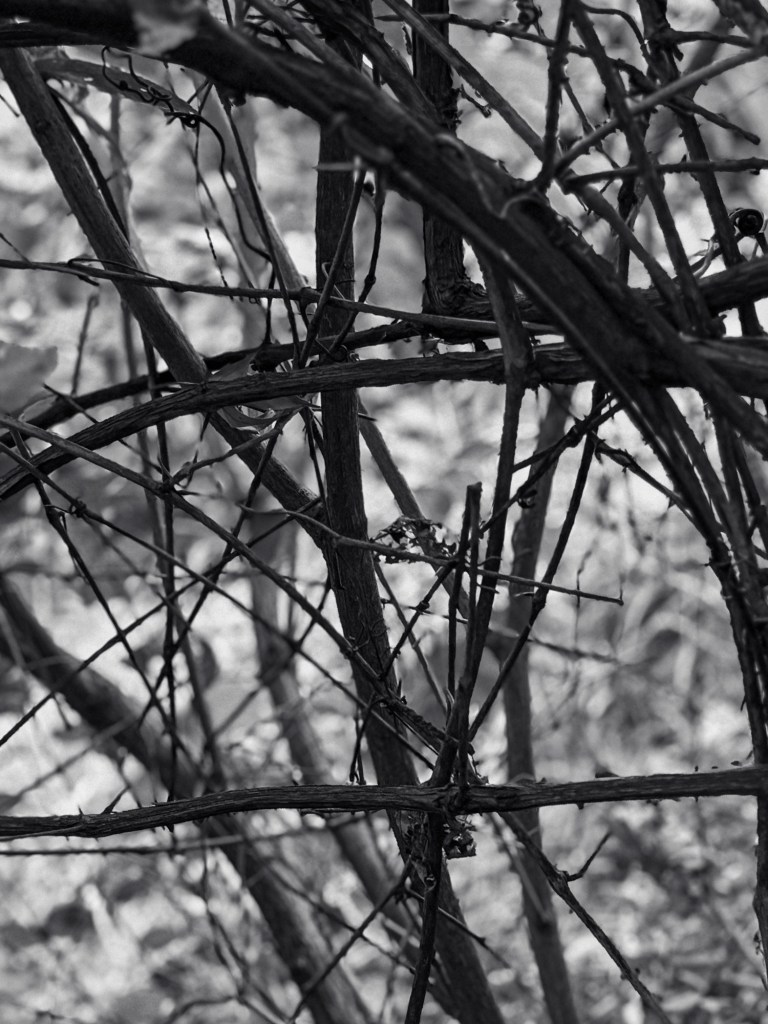
  • 📸 Learning to Look Closer #15: What Still Grows Here

    At first, it looked dead.

    A mess of old vines.

    Twisted branches.

    Things crossing over each other so tightly I couldn’t tell what was still alive—

    and what had been gone for a long time.

    That was what made me stop.

    In black and white, the whole thing looks stripped down to bone.

    No color to soften it.

    No green to reassure you that something is still growing.

    Just shape.

    Shadow.

    Tangles.

    Old wood wrapped around older wood.

    Somewhere inside all of that, something is still alive.

    I think that’s what I like about it.

    Nature doesn’t wait for everything dead to disappear before it starts again.

    It grows around it.

    Through it.

    Over it.

    The old damage stays.

    The broken pieces stay.

    Sometimes the dead things become part of the structure holding the living ones up.

    There’s something very October about that.

    Not death exactly.

    The space between death and whatever comes next.

    The point where something has already ended, but hasn’t disappeared.

    Where decay and growth are touching.

    Where you can’t quite tell which one you’re looking at anymore.

    And maybe that’s why the picture feels a little unsettling.

    Nothing is clean.

    Nothing is finished.

    Nothing has politely stepped aside to make room for what comes after it.

    Everything remains tangled together.

    Which, if I’m being honest, feels a lot more truthful than the idea that we always leave old things neatly behind.

    Sometimes we don’t.

    Sometimes we grow around them.

    Sometimes they become part of us.

    Sometimes the thing you thought was dead is simply waiting somewhere beneath everything else.

    And sometimes—

    you have to look closer to figure out which is which.

    Until next time,

    — Destiny

    P.S. What’s something you thought was gone, only to realize part of it was still growing somewhere underneath? 🖤

  • 🧠 Brain Static #13

    Apparently, zombie ants are real.

    Well.

    Kind of.

    There are fungi in the Ophiocordyceps group that infect certain ants and eventually alter their behavior.

    The infected ant leaves its normal routine, climbs onto vegetation, and clamps its jaws down.

    Then it dies.

    And the fungus grows out of its body so it can release spores and infect more ants.

    So basically—

    the fungus uses the ant as transportation, decides where it would like the body parked, kills it there, and then uses the corpse to reproduce.

    🍄

    Nature really looked at zombies and said:

    I can do that.

    Anyway.

    Happy October.

    You’re welcome for the unnecessary information. 🖤

    Until next time,

    -Destiny

    P.S. If you knew an animal had been infected by something that could control its behavior, would you want to know how it worked—or would you rather remain blissfully ignorant?

  • 🐇 Down the Rabbit Hole #4

    Why Does the Human Brain Think Something Is There?

    I need to know why my brain becomes an asshole after dark.

    Because during the day, I can look across a room and see:

    A coat.

    A pile of laundry.

    A chair.

    Completely normal things.

    Turn the lights off?

    Suddenly there is a whole-ass person standing in the corner of my bedroom.

    My stomach drops.

    My heart does that horrible little oh fuck thing.

    I turn the light on.

    Coat.

    Of course it’s a coat.

    It was always a coat.

    But for approximately half a second, my brain was completely prepared to accept that someone had broken into my house just to stand silently in the corner and stare at me.

    Rude.

    And I know I’m not the only person whose brain does this.

    A tree has a face.

    A car looks angry.

    An electrical outlet looks shocked.

    Something moves in your peripheral vision and you turn around because you could have sworn somebody just walked past you.

    Sometimes there isn’t even anything to see.

    You just suddenly get that horrible feeling that—

    someone is there.

    So naturally, I had questions.

    Why does the human brain keep finding people who aren’t there?

    Why does darkness make everything creepier?

    Why can two dots and a line suddenly become a face?

    And, most importantly:

    Why is my laundry trying to kill me at 3:00 in the morning?

    Down the rabbit hole I went.


    🕳️ First of all: apparently, your brain is guessing.

    I always kind of thought vision worked like a camera.

    Your eyes see something.

    Your brain gets the picture.

    Done.

    Apparently—

    no.

    Perception is much messier than that.

    Your brain is constantly taking information from your senses and trying to figure out what that information probably means.

    Most of the time, it happens so quickly that we never notice.

    You don’t stare at four wooden legs, a flat surface and a backrest while consciously calculating:

    Hmm.

    Interesting.

    I believe this may be…

    a chair.

    You just see a chair.

    Your brain already handled the rest.

    The problem starts when the information coming in isn’t very good.

    Maybe it’s dark.

    Maybe you only saw something for a second.

    Maybe half of it is hidden.

    Maybe it’s sitting at the edge of your vision.

    Your brain still wants an answer.

    So sometimes it gives you one before it has enough information.

    PERSON.

    …

    Never mind.

    Lamp.

    And suddenly my nighttime stupidity makes considerably more sense.


    🕳️ Apparently, everything has a face.

    There is a word for one particularly weird version of this:

    pareidolia.

    Pareidolia is basically what happens when we recognize a familiar or meaningful pattern in something that doesn’t actually contain that thing.

    And humans are really good at finding faces.

    Clouds.

    Trees.

    Houses.

    Food.

    Cars.

    Rock formations.

    Outlets.

    Toast.

    Apparently our standards are embarrassingly low.

    Two vaguely eye-shaped things and something underneath them?

    Good enough.

    Congratulations. You’re a face now.

    😂

    The weird part is that our brains actually respond to these fake faces.

    In a 2020 study, researchers showed people ordinary objects containing face-like patterns. The brain initially represented those illusory faces similarly to real faces before very quickly sorting them back into the “actually, that’s an object” category. 

    Which means there are tiny moments when your brain essentially does this:

    HUMAN.

    …

    toaster.

    And I absolutely love that.

    There is also an actual neuroscience study called “Seeing Jesus in Toast.”

    I’m not making that up.

    Researchers showed people visual noise and asked them to search for faces. Participants sometimes reported seeing faces even though there were none actually hidden in the images, and activity in a brain region involved in face processing increased when they did. 

    So apparently if you give the human brain enough visual nonsense, eventually it will manufacture a person.

    Excellent.


    🕳️ Turn off the lights and suddenly your coat is a murderer.

    Here’s where this becomes October appropriate.

    😂

    During the afternoon, that pile of laundry in your room is:

    laundry I should probably put away.

    At 3:00 in the morning?

    WHO THE FUCK IS SITTING IN MY CHAIR?

    Nothing about the laundry changed.

    Your information did.

    When there isn’t much light, you lose detail.

    Shapes get less clear.

    Edges blend together.

    Shadows hide parts of objects.

    Your brain is trying to identify something while working with less information.

    So it fills in some blanks.

    And sometimes the answer it lands on is—

    person.

    It also explains why watching a horror movie can suddenly make your perfectly ordinary house feel suspicious.

    The refrigerator makes a noise.

    Normally:

    Refrigerator.

    After two hours of watching people get murdered because they insisted on investigating strange noises:

    Well. This is how I die.

    Tree branch scratches the window?

    Murderer.

    Cat knocks something over?

    Demon.

    Boyfriend rolls over in bed?

    Possessed.

    😂

    Nothing necessarily changed inside the house.

    You did.

    You’re paying attention to different things.

    You’re expecting different possibilities.

    And now every weird shadow gets an audition for the role of whatever horrible thing you just watched.


    🕳️ Okay…but what if you don’t see anything?

    And then I found the part I really didn’t like.

    Because sometimes people don’t mistake anything for a person.

    There’s no coat.

    No shadow.

    No face.

    Nothing moves.

    They simply feel like—

    someone is there.

    Researchers call this a felt presence or sensed presence.

    It refers to the experience of feeling that another person or being is nearby without clear sensory evidence that anyone is actually there. 

    And apparently this is a whole thing.

    It has been reported in very different situations—including under psychologically or physically demanding conditions and alongside some neurological and psychiatric conditions—and researchers don’t think there is necessarily one explanation that accounts for every version of it. 

    It isn’t limited to people with a diagnosed condition either.

    A 2024 study surveyed 10,447 people from the general population. About 1.6% reported experiencing a felt presence during the previous month. Poor sleep and loneliness were among the things associated with the experience in that sample. 

    Which is fascinating.

    I hate it.

    But fascinating.

    Because apparently your brain doesn’t even need to bother making the coat look like a person.

    Sometimes it can just quietly announce:

    Someone is behind you.

    And provide absolutely no further information.

    Thanks.

    Very helpful.


    🕳️ So…is your brain lying to you?

    Not exactly.

    And I think this might be the part I find most interesting.

    Your brain isn’t sitting inside your skull intentionally making shit up because it’s bored.

    It’s interpreting.

    Constantly.

    The world doesn’t arrive in your head with helpful little labels attached.

    Coat.

    Tree.

    Shadow.

    Not a murderer.

    Your senses give your brain information.

    Your brain has to figure out what probably caused it.

    Usually, that works so well that we don’t even realize it’s happening.

    But sometimes?

    The information is incomplete.

    And the first answer is wrong.

    That also doesn’t mean we can slap pareidolia onto every strange experience anyone has ever had and call the mystery solved.

    Sometimes we don’t have enough information to know exactly what somebody saw, heard or experienced.

    But we do know that the human brain is extremely good at finding recognizable patterns inside incomplete information.

    Especially faces.

    Especially people.

    Especially things that seem important.

    Which means the creepy part might not be that our brains occasionally get it wrong.

    The creepy part might be realizing how much guessing they’re doing when they get it right.


    🕳️ So about that person standing in your bedroom…

    There probably wasn’t one.

    The coat never moved.

    The tree outside your window does not have a face.

    Your electrical outlet isn’t horrified.

    Your car is not pissed at you.

    Probably.

    😂

    For that first split second, though, your brain was trying to answer a question before it had all the evidence:

    What am I looking at?

    And its first answer was:

    Person.

    Then you stopped.

    Looked again.

    Turned on the light.

    And gave your brain enough information to change its mind.

    Coat.

    Just a coat.

    Which means the next time something vaguely human-shaped is standing in the corner of my room at night, I now know exactly what I should do.

    Turn on the light.

    Not because something is there.

    My brain just needs more information.

    And honestly?

    So do I.

    Well.

    This was supposed to be a fun little question about why coats turn into murderers after dark.

    Instead I learned that my brain is constantly interpreting incomplete information, will recognize human faces in completely inanimate objects, and can apparently decide that another person is nearby without even showing me the imaginary person.

    Excellent.

    October is off to a great start.

    Rabbit hole successfully entered. 🐇🕳️

    Until next time,

    — Destiny

    P.S. What’s the creepiest thing your brain has ever turned into a person for half a second? 👀

    Sources & Further Reading

    For this one, I kept the sources fairly small because this isn’t History After Dark and nobody needs my entire neuroscience research trail. 😂 These were the strongest sources I used while trying to figure out why our brains insist on finding people in coats, toast and dark corners.

    Susan G. Wardle et al. — “Rapid and Dynamic Processing of Face Pareidolia in the Human Brain.”
    Published in Nature Communications in 2020. This study looked at how quickly the brain responds to illusory faces in ordinary objects and found that those fake faces initially receive processing resembling that of actual faces before the brain rapidly distinguishes them as objects. 

    Jiangang Liu et al. — “Seeing Jesus in Toast: Neural and Behavioral Correlates of Face Pareidolia.”
    Published in Cortex in 2014. Researchers used visual noise to study what happens when people perceive faces that aren’t actually present and found involvement of the right fusiform face area during illusory face perception. Also still one of my favorite research-paper titles. 😂 

    Joseph M. Barnby et al. — “The Felt-Presence Experience: From Cognition to the Clinic.”
    A 2023 review examining felt presence—the experience of sensing another being nearby without clear sensory evidence—and the different neurological, psychological and environmental contexts in which it has been reported. 

    Sanne G. Brederoo et al. — “The Experience of Felt Presence in a General Population Sample.”
    Published in The British Journal of Psychiatry in 2024. The study surveyed 10,447 people and found that 1.6% reported a felt presence during the previous month, showing that the experience isn’t confined to unusual expedition stories or clinical populations.